
Last week the chief executive of Palantir, Alex Karp, went on CNBC and said the way artificial intelligence is sold to enterprises is not merely expensive but structurally wrong. "I'm not throwing shade at them," he said of the large model providers, "but something has gone completely wrong" (CNBC, 2026). The day before, his company had published a nine-point manifesto on AI sovereignty, and one line from it has stayed with me since: controlling your weights is controlling your fate (Palantir, 2026).
Mr Karp is a competitor of the companies he was criticising, and he had a partnership of his own to promote. I take the motive as given. But when someone with an interest says something true, the interest does not make it less true. It only tells you why they were willing to say it out loud.
Take the argument on its merits
So set the theatre aside and take the argument on its merits. When your organisation uses a shared AI service, you are handing over more than the confidential material I wrote about recently. Mr Karp put his finger on a second thing. He said serious customers want "control over their compute, their models, their data stack and their alpha." They want to know, in his words, that "they own the means of production" (CNBC, 2026). Alpha is an investor's word for the edge that makes you win. His claim is that the current model of AI consumption quietly transfers it.
The architecture puts them there
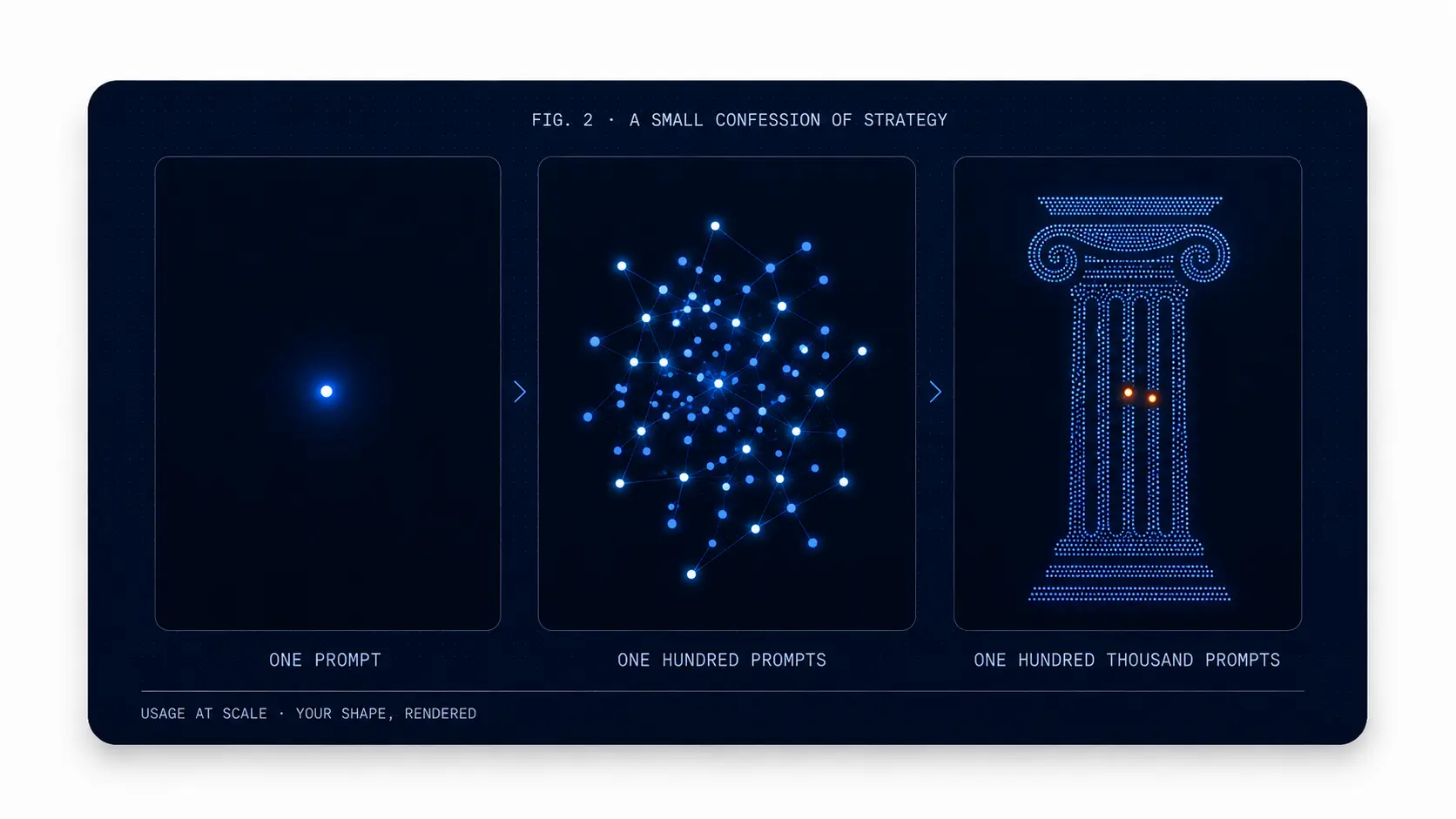
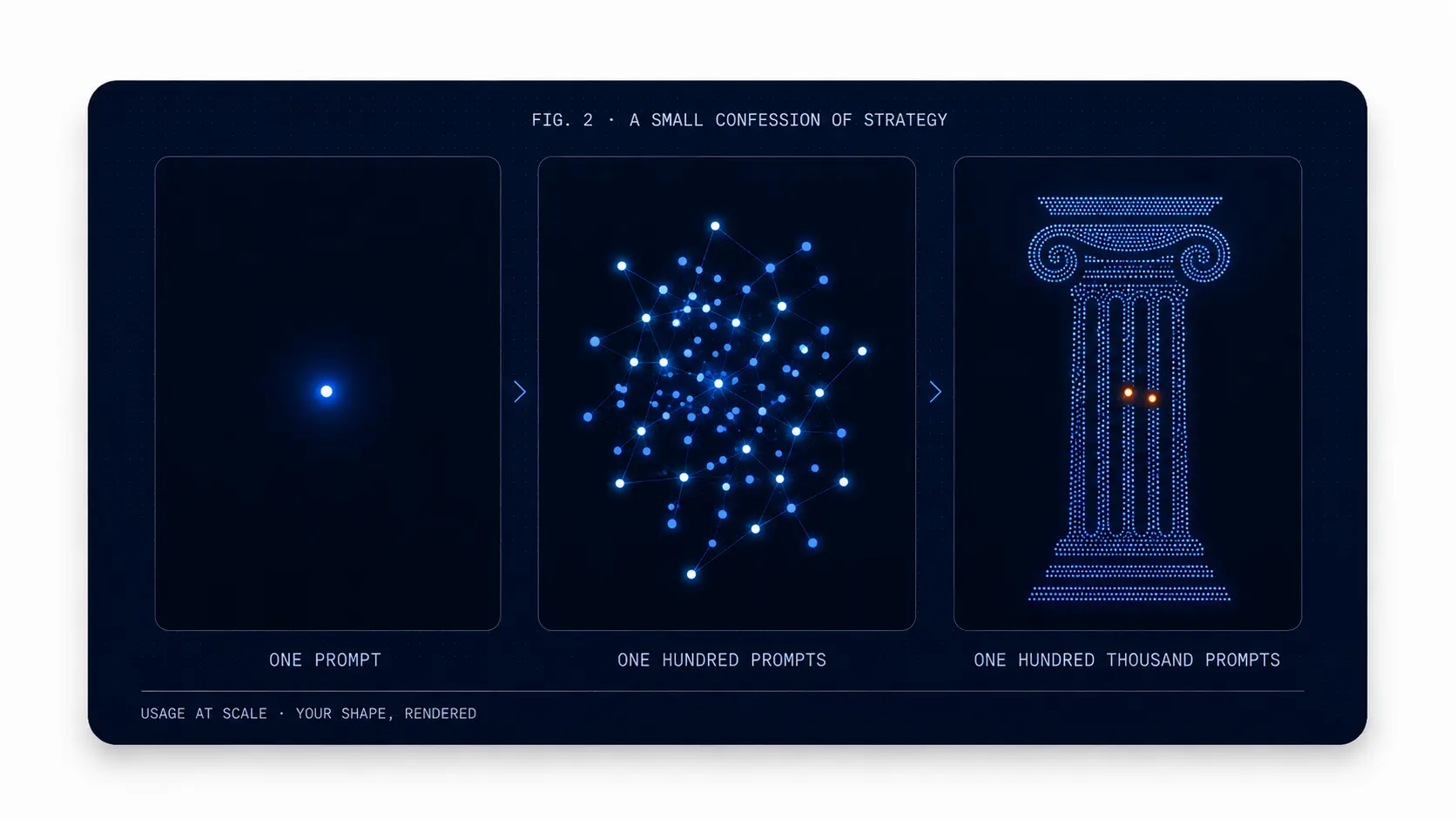
Here is why I do not think that claim can be dismissed. Every prompt your organisation sends to a shared AI service is a small confession of strategy. One prompt reveals nothing. A hundred thousand prompts, from your analysts, your lawyers, your product teams, describe with some precision what your organisation is working on and what it is about to do next. Whoever operates the service is in a position to see that shape. Not because anyone is behaving improperly, but because the architecture puts them there.
A partner one quarter can be a competitor the next
And the providers are no longer neutral utilities. They are becoming product companies with ambitions in the very markets their customers occupy. Consider one sequence from earlier this year, as reported by The Information and widely covered since. Figma, the design software company, had been an Anthropic partner, and in February the two collaborated on a feature connecting Claude's code generation to Figma's canvas. On 14 April, Anthropic's chief product officer resigned from Figma's board. Three days later, Anthropic launched Claude Design, a product aimed squarely at the workflow Figma monetises. Figma's share price fell roughly seven per cent that day (The Information, 2026; VentureBeat, 2026).
I want to be careful here, because fairness matters more than rhetoric. Nothing in the public record shows any customer's data was misused, and the resignation was arguably the proper thing for a director to do once a conflict emerged. My point is not about villainy. It is about structure. A partner one quarter can be a competitor the next, and when the firm that processes your organisation's daily thinking also builds products for your market, you are relying on its restraint.
Readers of my last piece will know where I stand on that. A promise can be forgotten, renegotiated, overridden by a change of strategy or a change of management. The incentives I have described do not require anyone to break a promise. They only require the promise to bend, slowly, in the direction the money points.
Your alpha stays where it was earned
The answer is not to abstain from AI. The productivity is real, and abstention is a competitive decision your rivals will thank you for. The answer is to change the architecture so the question never arises. If the model runs on hardware inside your own environment, your prompts and your patterns never leave you. If it runs in a sealed, attested environment that is cryptographically closed to everyone including the operator, then the operator cannot see your usage, cannot learn your shape, and can prove it. Your alpha stays where it was earned. That is what sovereignty means at the scale of an organisation: not a manifesto, just custody you can evidence.
Decide who is able to watch it think
Mr Karp shouted, because shouting is his medium. The quieter version of his point is the one I would put to any board I sat on. Your firm's working mind now passes through its tools. Decide, deliberately, who is able to watch it think. If the honest answer is a third party whose future products you cannot predict, then you have taken on a silent partner, and you did not negotiate the terms.
A map you did not have before
We help organisations answer that question in a single half-hour session: mapping where their data and their usage actually go today, and what it would take to hold both provably. Thirty minutes, and you leave with a map you did not have before - just send me a message. But whether or not we ever speak, do consider this. It is your alpha. It should be your architecture.
Ferdie Pieterse is the Chairman of PrivateBox and the former Chief Executive Officer of Experian Africa.
References
Business Insider (2026) Inside Cursor's chaotic rise, from its Anthropic situationship to dating SpaceX. Available at: https://www.businessinsider.com/cursor-ceo-michael-truell-spacex-elon-musk-anthropic-2026-6 (Accessed: 4 July 2026).
CNBC (2026) Palantir's Karp bashes token-based AI model as 'completely wrong'. Available at: https://www.cnbc.com/2026/07/01/palantir-karp-open-ai-anthropic-tokens.html (Accessed: 4 July 2026).
Palantir (2026) On the importance of AI sovereignty [nine-point manifesto posted on X, 30 June 2026]. Available at: https://x.com/palantirtech/status/2072114267776491695?s=46 (Accessed: 4 July 2026). Reported in CNBC (2026), above.
The Information (2026) Exclusive: Anthropic Preps Opus 4.7 Model, AI Design Tool, 14 April. Available at: https://www.theinformation.com (subscription required). Reported in: TechCrunch (2026) Anthropic CPO leaves Figma's board after reports he will offer a competing product. Available at: https://techcrunch.com/2026/04/16/anthropic-cpo-leaves-figmas-board-after-reports-he-will-offer-a-competing-product/ (Accessed: 4 July 2026).
VentureBeat (2026) Anthropic just launched Claude Design, an AI tool that turns prompts into prototypes and challenges Figma. Available at: https://venturebeat.com/technology/anthropic-just-launched-claude-design-an-ai-tool-that-turns-prompts-into-prototypes-and-challenges-figma (Accessed: 4 July 2026).